Hank Over Display Font for Handmade Labels & Printables
As a small shop owner who designs printable wall art, wedding tags, and boutique packaging for candle makers and soap sellers, I’m always hunting for display fonts that do more than just look pretty—they need to work. That’s why Hank Over landed in my cart and hasn’t left my go-to folder since. It’s not just another faded typeface; it’s a quiet showstopper—softly weathered, effortlessly warm, and built for real-world craft use.
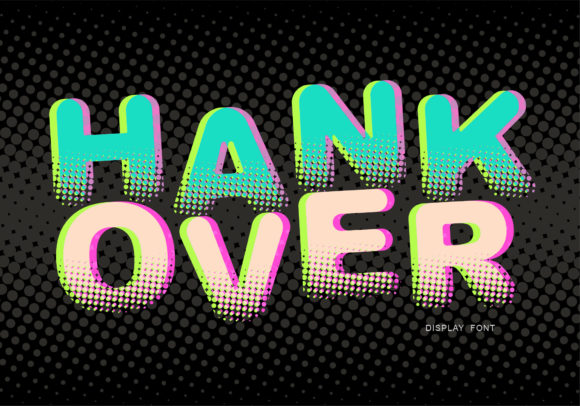
Hank Over is a display font with gentle fading, subtle texture, and balanced letterforms that avoid the “overly distressed” trap. Its lowercase letters have relaxed proportions and open counters, making it surprisingly legible even at 18–24pt on product labels or 3x5” greeting cards. The uppercase has presence without shouting—ideal for names on wedding welcome boards or shop signage where charm matters more than sharpness. It leans rustic but doesn’t scream “farmhouse”—it works just as well on a minimalist birthday invitation or a vintage-inspired mug design.
I’ve used Hank Over across six different physical product lines—and each time, it elevated perceived quality. On kraft paper candle labels? Yes—it softens the contrast while keeping the brand name crisp and memorable. On matte-finish sticker sheets for planners? Absolutely—the faded texture reads beautifully when cut on a Cricut Explore Air 2 or Silhouette Cameo 4. And on printed SVG-style wall art (think “Gather,” “Bloom,” or “Hello, Summer”), Hank Over adds tactile warmth without needing extra layering or shadow effects.
Readability is where many faded display fonts stumble—but Hank Over holds up. At 14pt on a 2” product tag, it remains clear under natural light and scans cleanly in mockup previews for Etsy listings. For stickers under 1.5”, I stick to short words (“Joy,” “Home,” “Love”) or initials—never full sentences—and it performs consistently. When paired with a clean sans serif like Montserrat or Lato for body text, the contrast feels intentional, not jarring. That pairing also helps maintain brand consistency across digital downloads, social media graphics, and physical packaging.
For wedding stationery designers: Hank Over shines on “Welcome” signs, menu cards, and foil-stamped escort tags. Its faded character echoes hand-painted signage but scales perfectly for laser-printed vellum overlays or printable PDF templates. I recently used it for a set of editable bridal shower printables—guest list pages, drink station labels, and photo booth props—and buyers specifically mentioned how “effortlessly elegant” the typography felt compared to busier script fonts.
Seasonal crafters will appreciate how Hank Over adapts. Swap out “Merry” for “Happy” and it’s perfect for July 4th bunting. Layer it over a watercolor background for autumn market banners, or pair it with linen-textured SVG frames for spring-themed planner pages. Because it’s designed as a display font—not meant for paragraphs—it keeps your focus where it belongs: on impact, emotion, and clarity.
Font pairing is intuitive. Try Hank Over with a friendly handwritten font (like “Quicksand” or “Dancing Script”) for invitations where you want hierarchy and personality. Or balance its faded charm with a sturdy serif like Merriweather for product descriptions on boutique packaging. Avoid pairing it with other distressed or ultra-thin fonts—that dilutes its uniqueness. Let Hank Over lead, then support with simplicity.
In terms of technical use: Hank Over comes as a standard OTF file—fully compatible with Canva, Adobe Illustrator, Silhouette Studio, and Cricut Design Space. No ligatures, swashes, or stylistic alternates are included (based on current version), which keeps things predictable for production. That’s actually a plus when you’re batch-printing 200+ labels or prepping SVG bundles for digital download shops—you don’t have to troubleshoot glyph substitutions mid-run. It supports basic Latin characters, so it’s reliable for English-language products, shop names, and common punctuation used in craft contexts.
Licensing is non-negotiable—and here’s the practical note every handmade seller needs: Hank Over includes a commercial license. That means you can use it in physical products you sell (stickers, mugs, tote bags), digital downloads (printable planners, Canva templates), client work (custom invitation suites), and even merchandise made via print-on-demand services. Just double-check the license file for any restrictions around resale of the font file itself (which is standard—don’t redistribute the OTF). As long as your end product is transformed—text set in Hank Over on a printable, not the font file alone—you’re covered.
What sets Hank Over apart isn’t just its aesthetic—it’s how quietly capable it is. It doesn’t demand attention, but it earns it. Whether you're designing for a local farmers’ market booth or scaling up an Etsy shop with 500+ digital listings, this display font delivers consistency, warmth, and quiet professionalism. It’s the kind of typeface that makes customers pause, smile, and remember your brand—not because it’s flashy, but because it feels *true*.
If you’ve been reaching for the same two script fonts for every project, try swapping one in for Hank Over. Use it for your next batch of gift tags, seasonal SVG bundles, or printable wall quotes. See how its faded elegance lifts your whole lineup—not with noise, but with nuance.